Buddhist Cultural Tour - 10 Days
 Fullscreen
4.9 ★★★★★
Tripadvisor reviews

Activity
Tour
Duration
10 Days

Grade
Easy Plus
Overview
Many people are surprised to learn that Lord Buddha was actually born in Nepal! Here in the western region of the Terai, in Lumbini, Buddha’s mother, Maya Devi, gave birth next to a beautiful reflecting pond. A temple marks the sacred spot where it happened. Lord Buddha grew up in present-day Nepal, was married, and had a son before he departed on his quest for enlightenment.
The Buddhist Cultural Tour is a truly amazing spiritual experience for both Buddhists and non-Buddhists alike. Nepal is home not only to the birthplace and early palace of Prince Siddhartha but is also home to some of the most amazing monasteries and holy sites in all of Buddhism. The Kathmandu Valley contains some truly amazing places where you can experience Mahayana Buddhism at its finest.
The Buddhist Cultural Tour takes you on a profound journey of peace and harmony to Nepal's sacred Buddhist sites, as well as places where you can experience the spirituality and mystery of this sacred land. This epic journey will take you to Lumbini, Kathmandu, and Pokhara to see and experience some of the most amazing places that will touch your very soul as you seek true enlightenment. Once in Nepal, you will understand why Lord Buddha found enlightenment in the shadows of the sacred and holy Himalayas.
Trekking Mart heartily welcomes you to the birthplace of Lord Gautam Buddha. The Buddhist cultural tour in Nepal welcomes you to a profound journey of peace and harmony through the birthplace of Buddha, with a focus on sacred sites in Kathmandu, Lumbini, and Pokhara. This unique tour is for religious pilgrims, spiritual seekers, history enthusiasts, and those seeking peace, enlightenment, and a deeper connection to the root of Buddhism.
The 9-day Buddhist Cultural Tour encompasses all the Buddhist pilgrimage sites, including Lumbini, Swayambhunath, Boudhanath, Namobouddha, and many more. The trip brings you closer to places that uphold the wisdom of Gautam Buddha as best expressed in the peace, harmony and tranquility of the world’s highest mountains.
The Buddhist Cultural Tour starts from Kathmandu, a center of cultural values. UNESCO heritage sites include Swayambhunath and Boudhanath, as well as Lumbini, which are major Buddhist destinations. The journey leads us to Pokhara’s eco-cultural fraternity. We’ll visit the World Peace Pagoda and the Tibetan refugee center. Then we’ll go to our core destination—Lumbini (birthplace of Lord Buddha). Here you’ll visit various sacred sites and monasteries built by many countries, each displaying their Buddhist experience. The Maya Devi temple is located in the heart of Lumbini and is considered the most precious pilgrimage destination for all Buddhists.
Trekking Mart is pleased to be able to offer you the Buddhist Cultural Tour. Our experienced guides are all from the Himalayas and are fully knowledgeable about Buddhism and its role here in Nepal. Let the Trekking Mart family take you on this incredible spiritual journey to the Land of Lord Buddha.
Highlights of the Trip
Visit Lumbini, a UNESCO World Heritage Site where Lord Buddha was born.
Experience the essence of wisdom spread by Lord Buddha
Be touched as you explore various pilgrimage sites related to Buddha and Buddhism
Experience peace, enlightenment, and a deeper connection to the roots of Buddhism
Gaze upon the mighty Annapurna Mountains, Pokhara city, and Lake Phewa from the International Peace Pagoda.
Discover the amazing culture and food of Nepal
Enjoy the journey of peace and harmony that only a Buddhist Cultural Tour can bring
Itinerary
This spiritual journey begins even before you land at the airport in Kathmandu. On clear days, the snow-capped Himalayan peaks greet you from your plane’s window, with lofty Mount Everest visible to the east. It is a beautiful sight referred to by the local Sherpa people as “The Mother Goddess of the Earth." Upon arrival, your Trekking Mart representative will be waiting to welcome you at the arrival gate and transfer you to your hotel, and the rest of the day will be spent relaxing from your long journey.
In the evening, immerse yourself in Nepal’s vibrant culture. You’ll be treated to authentic Nepali cuisine and a cultural dance performance to experience the country’s distinct spirit.
Our second day features the tour to two of the most important stupas in the valley:
Swayambhunath
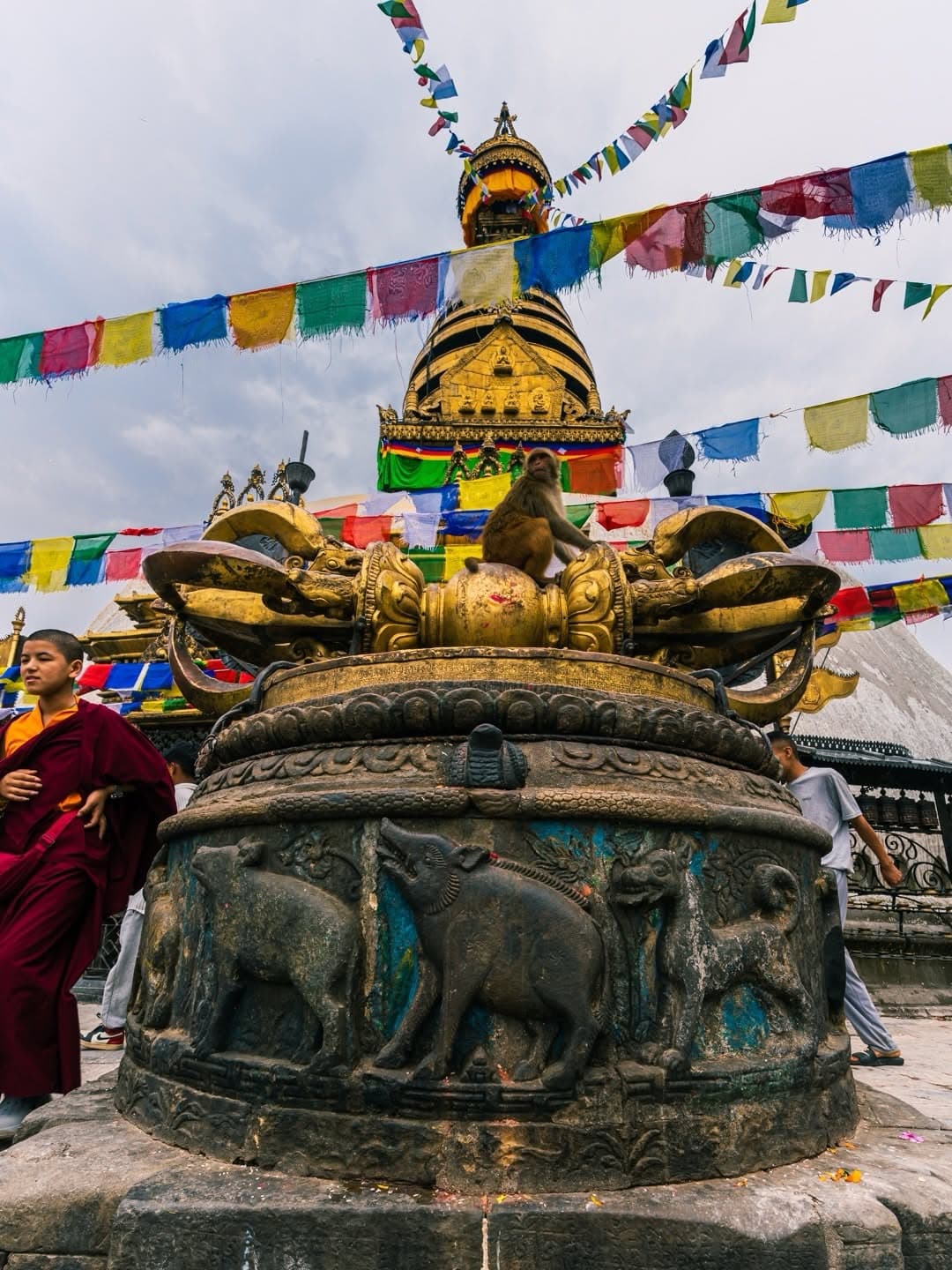
Swayambhunath is one of the holiest Buddhist stupas, meaning “self-existent one," and is said to have evolved spontaneously over 2000 years ago when the valley was formed from a primordial lake. It is believed that the stupa was born out of a lotus flower blooming in the middle of the lake. There are many shrines and monasteries on the grounds of this stupa, which is the oldest of its kind in Nepal. One of the stupas even contains a bone from Lord Buddha himself. The sacred hilltop sites offer panoramic views and ancient legends. The stupa is nicknamed the "Monkey Temple” because of the large number of Rhesus monkeys living on the stupa hill, and they are also referred to as guardians of the site. The stupa has stood as an example of religious harmony because of its importance to both Buddhists and Hindus.
Boudhanath
Boudhanath Stupa is one of the largest spherical stupas in the world and the largest in Asia. Built in the 14th century and listed as a UNESCO World Heritage Site in 1979 AD, it is a key Buddhist pilgrimage site and was originally named Khasti Mahachaitya, with "Khasti" referring to dewdrops. Legends suggest that the stupa was built with water collected from dewdrops using a large sheet of cloth during a drought. The Boudhanath stupa is believed to entomb the relics of Kassapa Buddha (the first Buddha). The stupa is surrounded by the largest Tibetan Buddhist refugee site in Nepal. The stupa is surrounded by various bookstores and shops selling unique Tibetan Buddhist items.
The next day features a cultural tour to Patan, a Buddhist city in the ancient Hindu Kingdom of the Mallas, and a trip to Chovar.
Patan is one of the oldest Buddhist cultural sites in Nepal and highlights the deep Newari Buddhist architecture, Vajrayana traditions, and ancient monasteries. At Patan, you can also witness the four 3rd-century BCE Ashoka Stupas. Key highlights of Patan are:
Hiranya Varna Mahabihar (Golden Temple). This extravagant temple with golden roofs dates back to the 12th century. This place has a unique tradition of having young priests from the community known as Bapacha.
Mahabouddha (Temple of a Thousand Buddhas): The temple is covered in thousands of terracotta Buddha images. Legend says it was inspired by the Mahabodhi Temple in Bodh Gaya, India—the site of the Buddha's enlightenment—and built to bring that sacred energy into the valley. After being destroyed in the 1934 earthquake and lovingly rebuilt, the leftover bricks were used to construct a small Maya Devi shrine nearby.
Rudra Varna Mahabihar: In the afternoon we’ll descend to the sacred gorge of Chovar, where the holy Bagmati River cuts through the valley rim in a series of waterfalls and rapids. According to both legend and geology, the Kathmandu Valley was once a vast lake. Legend has it the Bodhisattva Manjushri, who came from the north, drew his flaming sword, and cut the southern rim of the valley—creating the gorge at Chovar—to drain the waters and make the land habitable for humanity. We will visit the Asur cave (Asura Gupha), Asura meaning "demon" in Sanskrit. According to legend, this dark cleft in the Chovar hillside was once inhabited by a powerful demon (asura) who terrorized the valley. Guru Padmasambhava came to this cave, meditated, and subdued the demon through the power of compassion and tantric practice, transforming its destructive energy into a protector of the Dharma. Buddhist practitioners, particularly of the Nyingma tradition, visit this cave as a place of spiritual power.
We will also visit the Vajrayogini temple and light a stick of fragrant incense. The Chovar ridge and village below support a cluster of small Buddhist monasteries, many belonging to Tibetan Nyingma and Kagyu lineages, established by Tibetan refugees and their Nepali disciples over the last seven decades. These modest gompas, some no larger than a single prayer hall, are among the most authentic meditation environments in the valley. The Jal Binayak shrine and the hillside monastery here are sites of quiet, meditative power—perfect for reflection and silent, reflective sitting.
Today, after breakfast, we will drive for around one and a half hours east of the Kathmandu Valley to the hills of Namobuddha, one of the most revered Buddhist pilgrimage sites in Nepal. This place is known for compassionate love and sacrifice (bodhichitta). According to ancient legend, Prince Mahasattva, a previous life of Lord Buddha, offered his own body to a starving tigress and her four young cubs here, the ultimate act of compassionate love. The hilltop stupa and the magnificent Thrangu Tashi Yangtse Monastery are definitely worth visiting. We can spend the afternoon in guided meditation, walking the kora path among monks and pilgrims in a profound atmosphere of stillness. On clear days, the snowcapped peaks of the mighty Himalayas form a perfect backdrop to this magnificent day.
Today's journey is marked by the scenic drive along the Prithvi Highway to Pokhara. The journey takes us over the top of the ridge and along the rushing Trishuli River that bisects Nepal. After around a 6 to 7-hour drive, we will arrive at the lakeside alpine city of Pokhara in the afternoon. After checking into the hotel and freshening up, we have a free evening for a peaceful lakeside stroll or maybe sunset boating in Phewa Lake. Pokhara features many Buddhist sites and is also home to Tibetan refugees.
Pokhara's spiritual landscape is as breathtaking as it is a natural one. We will start with the hike/drive to the World Peace Pagoda (Shanti Stupa), a white 115-foot-tall stupa on the ridge of Phewa Lake. Nestled on a 1100-meter-high hill, the stupa provides an ideal perspective of the city, picturesque Phewa Lake, and the Annapurna range. This place is perfect for sunrise meditation when the mighty Annapurna Mountains turns a rich, golden hue.
We descend to the Tibetan refugee camp—a place for Tibetan refugees after the Cultural Revolution in China. People here have preserved the Himalayan Buddhist culture with great dignity. Their worship is truly authentic of Tibetan Mahayana Buddhism and may even be more authentic than in the Tibetan homeland these days. We will also explore the Malepatam Gompa there.
By late afternoon, there will be time for contemplation, wandering along the lakeside, exploring other sites, or engaging in other Pokhara activities. Pokhara offers so many opportunities to experience so much – you will absolutely fall in love with this enchanting place.
After breakfast, we will travel 200 km south to the Terai Plain of Lumbini, the birthplace of Sakyamuni Buddha. The road will lead us to the holiest ground in Buddhism. On the way to Lumbini, we will also stop at Ramgram, Parsa, to explore the Ramagrama Relic Stupa.
The Ramgrama Stupa is one of the eight original relic stupas where corporeal remains were enshrined. After the Mahaparinirvana, the body of Lord Sakyamuni (Siddhartha) Buddha was cremated by the Mallas of Kushinagar and the body remains were distributed among eight claimants, including the Koliyas of Ramagrama. The Koliya King, having enshrined the body relics of Lord Sakyamuni Buddha, erected the stupa with great devotion and reverence. This stupa is the only one that is still in its original form. Therefore, it is one of the holiest pilgrimage sites for Buddhists who dream of making a pilgrimage to Ramagrama at least once in their lifetime.
Arrive in Lumbini by late afternoon; check into your accommodation near the sacred garden. Participate in evening puja at the Maya Devi Temple by candlelight. If you are lucky enough to be at the Maya Devi Temple on a full moon, the spiritual experience is beyond description! The overwhelming sense of peace and harmony is beyond this world!
We will explore the important site of the whole journey. In 623 BCE, Queen Maya Devi gave birth to Siddhartha Gautama beneath an ashoka tree in this garden. The temple is therefore named the Maya Devi Temple. We will start from the sacred garden, offering prayers at the Maya Devi temple. Today we shall stand before the marker stone, touch the root of the holy Bodhi tree, and can also sit for meditation or a few minutes of silence inside the temple. We also witness the Ashoka Pillar (erected 249 BCE), the oldest Buddhist monument in existence, inscribed by Emperor Ashoka himself.
Spend the afternoon walking the World Peace Flame and the International Monastery Zone—a large area devoted to international monasteries that reflects Buddhism in countries around the world. The International Monastery Zone is separated into two parts by a central canal. There are around 32 monasteries and meditation centers in this area that have been constructed or are under construction, each representing the cultural heritage of the world of Buddhism. Here we can both observe and participate in chanting, pujas, and meditations. Next, climb up to the World Peace Pagoda, sit in silence, and get a view of the Dhauragari mountain range. Mt. Dhauragari is the seventh highest mountain in the world.
We can end with the evening guided experiencing a guided meditation at the sacred Maya Devi garden. As noted above, you can actually plan your Lumbini experience for the time of the full moon, as the full moon night at Maya Devi Temple is a beautiful, spiritual experience.
After breakfast at Lumbini, we will drive back to Kathmandu via the scenic highway passing from the Terai region and through the Middle Hills to Nepal’s capital city. It takes approximately 7-10 hours, but the time goes quickly as the landscapes continues to change on the journey back to Kathmandu. It’s a never-ending myriad of breathtaking scenery. We will check into our hotel and rest. It’s a great time to explore Kathmandu’s ancient streets or look for souvenirs.
What an amazing spiritual experience! It’s the final day and no doubt you probably don’t want to leave this sacred place. Nepal has a way of touching your very soul that keeps people coming back again and again.
Include / Exclude
Service Included
- ✓
All ground transfers as per the itinerary by luxury car/van/jeep/bus
- ✓
Hotel in Kathmandu of your choice with breakfast on a twin-sharing basis
- ✓
Sightseeing as per the itinerary
- ✓
English-speaking tour guide
- ✓
Entrance fees for monuments and temples
- ✓
Welcome Dinner with cultural show
Service Excluded
- ✘
Expenses of a personal nature, lunch, dinner, and drinks, unless stated in the itinerary
4.9 ★★★★★
Tripadvisor reviews
Activity
Tour
Duration
10 Days
Grade
Easy Plus
Essential Information
We've compiled some of our Frequently Asked Questions to help you learn more about this amazing trip.
All travelers (except Indian nationals) must have a passport valid for at least six months from the date of arrival in Nepal.
Tourist visas are available:
On arrival at Tribhuvan International Airport
At major land border immigration offices
At Nepali embassies and consulates abroad
Travel insurance is strongly recommended, especially for trekking and climbing activities. Your insurance should cover emergency medical treatment and evacuation. Although it is possible to travel without insurance, Trekking Mart requires a written declaration stating that you accept full responsibility if you choose not to have coverage.
The climate of Nepal is largely influenced by the monsoon season, resulting in distinct travel periods throughout the year:
Dry Season: October to May
Monsoon Season: June to September
No vaccinations are mandatory for entry into Nepal. However, travelers may consider the following vaccinations based on personal health needs, travel plans, and medical advice:
Cholera
Meningitis
Tetanus
Diphtheria
Typhoid
Gamma Globulin (for short-term protection against certain infections, such as hepatitis A)
It is recommended to consult a healthcare professional or travel clinic before your trip to determine which vaccinations are appropriate for you.
ATMs are widely available in Kathmandu and other major towns. Credit cards are accepted in most hotels, restaurants, and shops in tourist areas, though smaller establishments may prefer cash. Currency exchange services are available at Tribhuvan International Airport and throughout Kathmandu, including banks and licensed exchange counters. it is recommended to carry sufficient cash (in Nepalese Rupees) to cover:
Personal expenses
Extra meals and beverages
Tips and gratuities
Additional accommodation if required
Additional Tips
Withdraw or exchange money before starting your trek.
Carry small denominations for convenience in remote areas.
Inform your bank before traveling to avoid issues with card usage abroad.
Your safety is our highest priority. Trekking Mart guides are trained and experienced, and they have full authority to modify, cancel, or reroute any part of the itinerary, if necessary, due to safety concerns, weather conditions, or other unforeseen circumstances.